
Home Care CRM Built for Referral Growth
A home care CRM has one job that generic software gets wrong: it should help you build and keep the referral relationships your admissions depend on. Discharge planners, physicians, and facility administrators send you clients over years, not in a single transaction. Yet most agencies try to run those relationships through a sales tool built to close one-time deals. This is exactly where a purpose-built home care CRM changes how an agency grows.
Why a Generic CRM Fails Home Care Agencies
Most agencies begin with a spreadsheet, then graduate to Salesforce or HubSpot when the spreadsheet buckles. However, those tools were designed to sell products to companies, one deal at a time. Home care runs on a different rhythm. Your "deals" are relationships that mature slowly and pay off in a steady trickle of referrals, not a single closed sale. As a result, forcing a generic tool into that shape produces a system nobody on the marketing team actually uses.
By contrast, a home care CRM built for referral development tracks the things that actually drive census growth:
- Territory mapping that shows facility density and coverage gaps.
- Referral source categorization by type: hospital, SNF, senior living, physician, or attorney.
- Activity logging that captures in-person visits, not just emails and calls.
- Pipeline visibility organized by referral source, not by sales deal stage.
- Compliance-aware tracking that respects Anti-Kickback Statute boundaries.
What the Right Home Care CRM Should Track
The right platform organizes everything around referral source relationships. Specifically, that means every facility in your service area with its location and type, every named contact with their role and authority, every outreach activity with a date and an outcome, every referral received with conversion data, and every follow-up scheduled and completed. Ultimately, the visibility this produces is the difference between knowing your top five referral sources by name and knowing every facility in your territory by status, last touch, and pipeline value. For a closer look at where those relationships come from, see our guide to home care referral sources.
Why Maintenance Is the Hard Part
Building a contact list is easy. Maintaining it, however, is where most agencies break down. Hospital discharge planners expect fast response times and reliable follow-up, and a single missed touch can erode months of trust. Moreover, when a marketing liaison leaves, the knowledge in their head walks out the door unless the CRM already captured it. Consequently, agencies that grow consistently treat their home care CRM as the system of record, not an optional tool. For the full workflow, explore how we handle home care referral management across an entire territory.
How AtendiCare Approaches the Home Care CRM
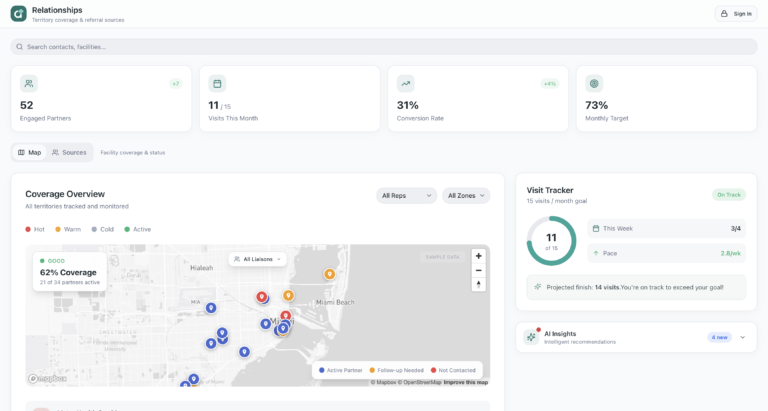
AtendiCare is a home care CRM built specifically for referral source relationships. For example, the territory map shows every facility in your service area, color-coded by coverage tier. The activity log captures every call, visit, and email with an owner attached. In addition, the pipeline view groups referral sources by category, while the admissions module routes new inquiries to your intake team for a fast response. Just as important, it keeps your referral history intact even when staff change.
A home care CRM only earns its place when it makes referral growth more predictable without adding headcount. To see what that looks like for your service area, request a custom AtendiCare preview and we will map it to your territory.